
Why a Security Data Fabric Is Essential for Multi-Framework Security Compliance


Free the CISO, a podcast series that attempts to free CISOs from their shackles so they can focus on securing their organization, is produced by CIO.com in partnership with DataBee®, from Comcast Technology Solutions.
In each episode, Robin Das, Executive Director at Comcast under the DataBee team, explores the CISO’s role through the position’s relationship with other security stakeholders, from regulators and the Board of Directors to internal personnel and outside vendors.
Security and compliance teams face a persistent challenge: frameworks keep evolving, overlapping, and expanding. NIST updates controls, ISO expands requirements, CIS adds safeguards, and new regulations appear just as organizations finish mapping to the old ones. For most enterprises, the hardest part isn’t the frameworks themselves—it’s the data needed to satisfy them.
In a recent educational webinar, Components for Continuous Compliance and Risk Management, experts from ISMG and DataBee discussed how compliance dashboards built without clean, normalized, trusted data creates a false sense of security. Dashboards may show a yes/no answer, but without visibility into the underlying data and why an element is judged compliant or not, organizations risk missing material issues hidden beneath surface-level reporting.
In the webinar, the experts discussed how adopting a security data fabric helps enable alignment, efficiency, and continuous assurance across frameworks. Below are excepts and key insights from the webinar.
The Pain Point: Frameworks Change, But Fragmented Data Doesn’t
Every compliance framework expects organizations to prove:
- Evidence integrity
- Control effectiveness
- Traceability
- Repeatability
- Cross-control consistency
But most organizations rely on siloed tools, inconsistent data feeds, and point-in-time spreadsheets. These disjointed systems create blind spots, redundant testing, questionable reporting, and increased audit risk.
Dashboards built on incomplete or unnormalized data not only mislead, but they may also create bigger downstream risk. Without trusted data, even well-intentioned programs appear compliant on paper but fail under audit scrutiny.
Why a Security Data Fabric Is the Foundation for Modern Compliance
A security data fabric creates a unified, enriched, and normalized layer of security data across the entire enterprise. It becomes the foundation for multi-framework alignment and continuous, outcome-driven reporting with many inherent benefits including:
1. Flexibility to Interpret and Apply Frameworks Correctly
Robin Das, DataBee explained that frameworks are rigid, but environments are not. By unifying all security and enterprise data, teams can “slice and dice” the data in whatever way best aligns controls to their specific environment. This adaptability lets organizations meet framework intent—not just checkbox requirements.
2. Built-In Agility as Frameworks Evolve
ISMG, Tom Shields noted that regulations will continue to change. A security data fabric allows organizations to quickly adapt dashboards, controls, and reporting without rebuilding entire pipelines. As Das noted, having all data centralized allows rapid adjustments rather than long, painful re-engineering cycles.
3. Unlocking Regulatory Overlap and Reducing Duplicate Work
Duplicate testing wastes effort because teams must validate the same controls across multiple frameworks. A data fabric helps eliminate this by aligning unified datasets to many frameworks simultaneously.
In practice, identity sources, CMDB data, vulnerability feeds, and access logs inform multiple frameworks at once—NIST, ISO, CIS, PCI, and others. The same data powers multiple control families when stored in a single fabric.
4. Real-Time, Outcome-Driven Reporting
Traditional dashboards show pass/fail scores without context. A data fabric like DataBee enables:
- Summary + detailed views
- The “Why” behind each compliance gap
- The specific assets causing non-compliance
- Recommended steps to remediate
This aligns directly with the DataBee platform’s real-time dashboards, automated reporting, and audit-ready evidence traceability.
5. Continuous Controls Monitoring and Assurance
A security data fabric like DataBee supports continuous validation across assets, identities, vulnerabilities, and processes—moving organizations beyond static CCM to true continuous assurance.
This shift is essential as executives increasingly demand real-time risk visibility and defensible reporting across frameworks. The result is an enterprise where compliance is no longer a time-boxed activity—but an always-on capability.
How DataBee Professional Services Helps Organizations Get It Right From Day One
Das noted that implementing a security data fabric is strategic, and the DataBee Professional Services team helps organizations accelerate value and ensure alignment from the start with three core service offerings:
1. Strategic Risk & Compliance Consulting
Experts help organizations build a resilient compliance foundation through:
- Policy and control reviews
- Strategic roadmap development
- Framework alignment (NIST, ISO, CIS)
2. Executive Metrics Alignment
Teams translate technical metrics into board-ready insights, including:
- KPI assessments
- Executive briefing materials
- Visualization of framework gaps
3. Compliance Dashboard Accelerator
A rapid-start program that delivers:
- 2–3 interactive, real-time compliance dashboards
- Unified KPI/KRI visualizations
- 14-day post-deployment support
Together, these services help organizations realize immediate business value from their security data fabric—avoiding missteps and accelerating their journey to defensible, outcome-driven compliance.
Additional Resources
More posts
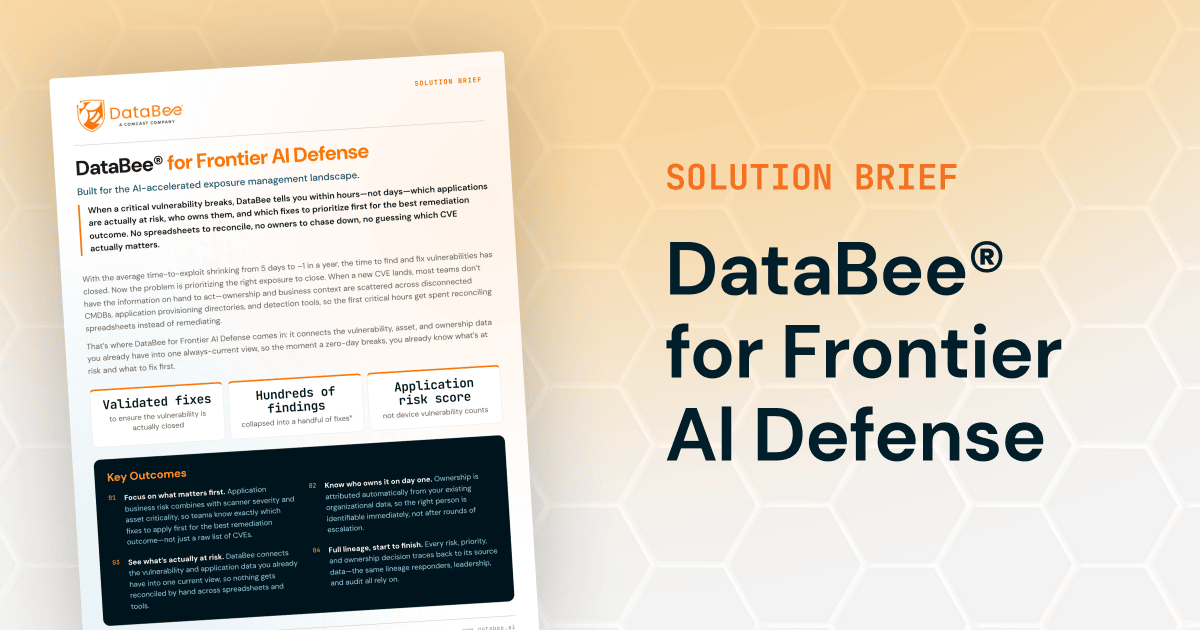

DataBee for Frontier AI Defense connects vulnerability, asset, and ownership data into one always-current view, helping teams prioritize risk and assess exposure faster.

Discover how DataBee® builds on the Open Cybersecurity Schema Framework (OCSF) to normalize, enrich, and correlate security data—enabling scalable, intelligent threat detection and analytics across your enterprise.

Streamline user access reviews without a standalone IGA tool. DataBee UAR delivers faster certification campaigns, built-in audit trails, and continuous, data-driven compliance using your existing identity data.
Get the clarity you need to manage cyber risk.
Schedule your 30-minute demo to see how DataBee's AI-powered technology turns your data into fast, clear, defensible control and cyber risk clarity.