
The Compliance–Resilience Paradox: Why Regulated Industries Must Move Beyond “Checklist Security”


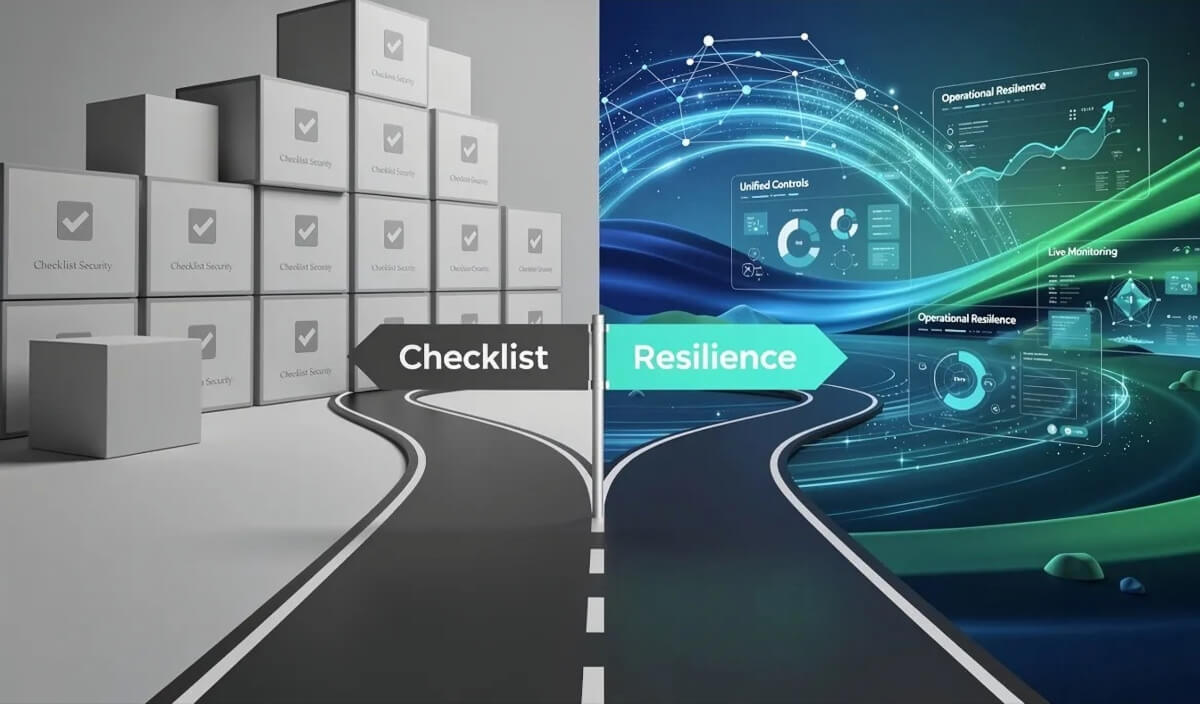
Free the CISO, a podcast series that attempts to free CISOs from their shackles so they can focus on securing their organization, is produced by CIO.com in partnership with DataBee®, from Comcast Technology Solutions.
In each episode, Robin Das, Executive Director at Comcast under the DataBee team, explores the CISO’s role through the position’s relationship with other security stakeholders, from regulators and the Board of Directors to internal personnel and outside vendors.
Financial services, healthcare, and critical infrastructure organizations are facing a turning point. Regulatory expectations are rising on all sides — DORA, updated HIPAA guidance, TSA directives, GDPR enforcement, and emerging AI-specific rules. At the same time, attackers are moving faster, using automation and AI to target both data and availability in ways traditional compliance frameworks were never designed to withstand.
For CISOs and CIOs in these sectors, one reality is now unavoidable:
Compliance proves alignment with required standards. Security ensures those standards hold up against real-world threats. Organizations need both — but only security can guarantee durable compliance.
Boards care about resilience, not just reports. Regulators increasingly expect continuous validation, not annual snapshots. Patients, customers, and citizens care about whether critical services are there when they need them. The mandate is shifting from “show me you’re compliant” to “show me you’re secure and resilient — and that your compliance posture reflects that.”
From Point-in-Time Assessments to Continuous Assurance
For years, regulated organizations have run on predictable rhythms: annual audits, quarterly certifications, scheduled penetration tests, prepared evidence folders, and rushed screenshot campaigns right before an external review. That cadence no longer matches reality.
Point-in-time assurance fails because:
- Cloud configurations change daily.
- Identities, roles, and entitlements shift constantly.
- New SaaS integrations appear between audit cycles.
- Control drift can emerge hours after a “clean” assessment.
Meanwhile, regulators and boards are increasingly focused on continuous assurance — the ability to demonstrate, at any moment, that critical controls exist, are designed correctly, are operating as intended, and are reducing risk in practice.
To do this, organizations need:
- Unified visibility into controls across security, IT, and business systems
- Automated evidence collection instead of manual artifact hunting
- Ongoing monitoring of control effectiveness, not one-time checks
- A connected view of how control gaps translate into business exposure
Most organizations don’t struggle because they lack frameworks. They struggle because control data is fragmented across tools, teams, and formats. Where that data is unified and normalized, compliance moves from a reactive reporting function to a defensible, operational capability.
Identity as the Real Perimeter
Network perimeters have effectively dissolved. Remote workforces, multi-cloud architectures, API-driven ecosystems, and the rise of non-human identities have pushed trust decisions out to the edges.
In regulated environments, identity now governs access to:
- Payment and trading systems
- Patient records and clinical applications
- Grid and industrial control systems
- High-risk AI models and data pipelines
The challenge is not just the volume of identities; it’s their distribution. Human accounts, service accounts, certificates, workload identities, and API keys are managed in different systems by different teams. When identity controls depend on manual reconciliation, attackers exploit the gaps between those systems.
Modern Zero Trust strategies in these sectors must focus on:
- Comprehensive discovery of human and non-human identities
- Clear mapping of entitlements to business and regulatory requirements
- Continuous validation of access, not static provisioning
- Behavioral monitoring to detect misuse and lateral movement
None of this scales when identity data is siloed. When it is unified and correlated with assets, controls, and activity, organizations can finally enforce least privilege and stop identity-driven incidents before they become reportable events.
Resilience as Operational Reality, Not a Buzzword
Threat actors targeting regulated industries increasingly aim to disrupt operations: halting patient care, freezing transaction flows, or impairing critical infrastructure. In that context, prevention alone is no longer a sufficient strategy.
Resilience is often defined in broad terms, but for practitioners and regulators, one moment matters most: what happens after something breaks.
A more precise way to articulate this is:
Resilience is the organization’s ability to continue operating under stress. Recovery is the moment where resilience is proven.
Operational resilience in regulated sectors now hinges on the ability to:
- Understand dependencies across critical systems and services
- Prioritize recovery based on business and safety impact
- Restore systems quickly with integrity and traceability
- Demonstrate, after the fact, that recovery followed policy and regulatory expectations
That depends on having clean, connected telemetry: asset inventories, configuration states, control performance, incident data, and business context that can all be aligned in real time. When these live in separate pockets, incident response and recovery become slow, manual, and difficult to defend under scrutiny. When they are unified, organizations can both recover faster and explain how and why they recovered the way they did.
Operationalizing Trust: Security and Compliance as One System
The core paradox in regulated industries is that compliance and security have too often evolved on separate tracks. One focuses on frameworks and audits; the other on threats and incidents. That separation is precisely what attackers and regulators are both exposing.
The path forward is to treat trust as an operational outcome, not a reporting function. That means:
- Integrating GRC with DevOps, SecOps, and cloud operations
- Designing controls that satisfy both regulatory requirements and real-world threat scenarios
- Automating evidence collection as part of normal security operations
- Mapping controls across frameworks so one implementation serves many obligations
- Replacing manual, one-off reporting with data-driven, continuously updated views
In this model, strong security becomes the engine of confident compliance. When controls are observable, measurable, and tested continuously, compliance reporting becomes faster, more accurate, and less adversarial. Legal and audit friction decreases, procurement accelerates, and regulators see not just policies, but proof.
Call to Action: Build a Unified Regulatory Control Inventory — for Security First
The most practical starting point for this transformation is not a new framework or another dashboard. It is a Unified Regulatory Control Inventory that connects:
- All controls tied to applicable regulations and standards (DORA, HIPAA, PCI, GDPR, TSA, NIST, etc.)
- The systems, identities, and processes that implement those controls
- The owners accountable for maintaining them
- The evidence required to prove they are operating effectively
- The business services and critical assets those controls protect
Crucially, this is not about chasing checkboxes. It is about gaining enough clarity over the control landscape to secure it.
When you:
- Know which controls exist and where they live
- Understand how they map to critical services and regulatory obligations
- See, in near real time, where they are drifting or failing…
…you can prioritize remediation, reduce real risk, and dramatically simplify audits.
Put differently:
You cannot protect what you cannot see. You cannot prove what you cannot unify.
Start by building the inventory for security and resilience. Compliance benefits as a result. In regulated industries, that is how you resolve the compliance–resilience paradox: by making security strong enough, visible enough, and connected enough that compliance becomes a natural, defensible outcome of how you operate.
For more insights on this topic, watch the webinar Beyond the AI Hype: How Global Enterprises Can Prevent the Next Wave of AI Silos
More posts


Webinar: Beyond the AI Hype: Preventing AI Silos in Global Enterprises. Discover how global enterprises can prevent AI silos using Governed Experimentation Zones. Learn from top BISOs and data leaders shaping AI governance at scale.
Create your own security compliance insights clearly, quickly and with confidence with DataBee® RiskFlow, a GenAI-powered tool within the DataBee® platform.

See how continuous assurance goes beyond CCM to deliver real-time validation, defensible evidence, and unified security data through a security data fabric.
Discover what DataBee can do for you

DataBee
Security, Risk and Compliance Data Fabric Platform
Developed and proven at scale, DataBee delivers connected security and compliance data and insights that can work for everyone in your organization.
Learn more
DataBee BluVector
Network Detection and Response
Built to protect critical government and enterprise networks, BluVector delivers AI-powered NDR for visibility across network, devices, users, files and data to discover and hunt skilled and motivated threat actors.
Learn more