


Free the CISO, a podcast series that attempts to free CISOs from their shackles so they can focus on securing their organization, is produced by CIO.com in partnership with DataBee®, from Comcast Technology Solutions.
In each episode, Robin Das, Executive Director at Comcast under the DataBee team, explores the CISO’s role through the position’s relationship with other security stakeholders, from regulators and the Board of Directors to internal personnel and outside vendors.
AI-Powered Attacks Changed the Rules. Most Security Programs Haven't Caught Up.
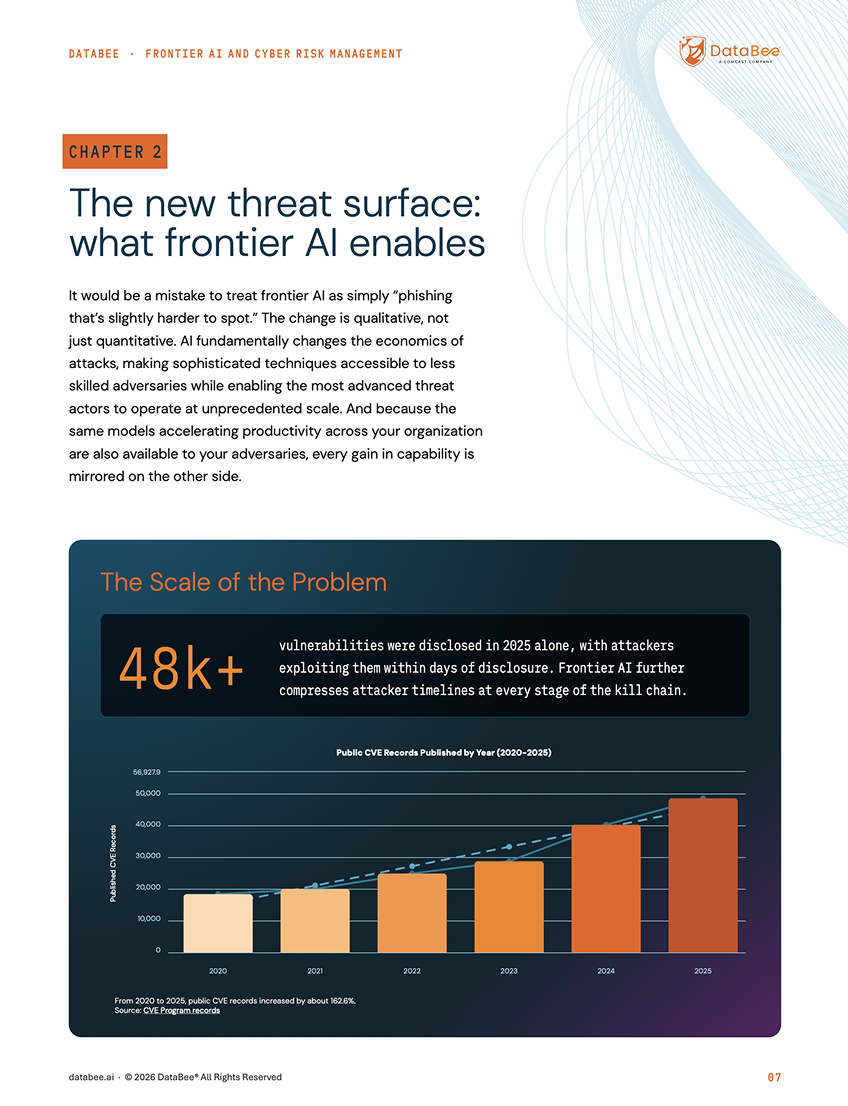
Artificial intelligence (AI) has fundamentally shifted the conversation around vulnerability management. For three decades, security teams focused on finding potential exposures in their architecture and either patching or mitigating the risk to limit the blast radius of a successful compromise. That worked well enough for most companies, but the release of frontier models like Claude Mythos and OpenAI's GPT-5.6-Cyber resulted in a flood of vulnerabilities.
This increased pace of discovery further upended traditional cybersecurity operations, which had already shifted in recent years toward more of a risk-based approach to vulnerability management. Now the need for this risk-based approach is even more acute. The problem is that most security operations haven't changed quickly enough to adopt this new paradigm, which has left them vulnerable to a savvier class of threat actor.
Security programs must adapt to the new world of AI-powered threats, and they can only do that with access to the right exposure data and concrete accountability.
The Real Problem Isn't Finding Vulnerabilities
For years, vulnerability management programs focused on identifying vulnerabilities, assigning severity ratings, and pushing findings into remediation workflows.
That approach worked when organizations had time. That window has vanished. In years past, teams had on average 63 days from a vulnerability being identified to finding the first exploit in the wild, according to the 2026 M-Trends Report from Google. In the same report, Google found that the time to exploit shrunk to negative 7 days in 2025. Recent reporting on frontier AI models indicates further erosion approaching near zero-days with models finding vulnerabilities and developing exploits simultaneously.
Security teams facing this challenging environment have multiple vulnerability scanners, endpoint security platforms, cloud security tools, threat intelligence feeds, and ticketing systems built for a time when the patching window existed.
All these systems have different data models and don't talk to each other effectively, shifting the issue away from discovering vulnerabilities. Security teams are already overwhelmed with findings and AI only adds more onto the pile. What slows remediation down is not confidently knowing the answers to these questions:
- Which business systems are exposed by this vulnerability?
- Who owns them?
- What should be fixed first?
- How much business risk does this create?
- Was the issue resolved?
Those seem like straightforward questions. In practice, they are remarkably difficult to answer.
The information required to respond often lives across multiple systems. Vulnerability scanners identify findings associated to a device or software library. CMDBs track device infrastructure. Application inventories identify business systems. Service management platforms coordinate remediation activities. Source code static analysis tools discover software and system dependencies. Ownership information may reside somewhere else entirely.
None of these systems were designed to create a single operational view of exposure.
As a result, security teams frequently spend the first critical hours of an incident trying to assemble context instead of reducing risk. This confusing data becomes a massive bottleneck to addressing the real risk of a breach.
AI-Powered Attacks Move Faster Than Your Response
Discover how CISOs and GRC leaders can navigate AI-driven cyber risks.



The Shift to Contextual Exposure Management
Defending against AI-enabled threats requires understanding the business context around the applications at risk when a new vulnerability is identified. Where classic exposure assessment tools provide insight into which server and device have a vulnerability, they lack the context around what application that relates to, the criticality of that application to the business, who owns the fix, and the ability to prove that a repair worked.
Beyond this business context, additional threat context is also critical for prioritizing vulnerabilities based on the real risk to your organization. If a CVE shows up on the U.S. Cybersecurity and Infrastructure Security Agency (CISA) list of Known Exploited Vulnerabilities (KEV), then it should likely be prioritized ahead of a CVE with a similar severity score that has not yet been actively used in an attack.
Using traditional scanning tools, security teams do their best knowing only which device has a vulnerability but lack the context of which application that relates to. A contextual approach to exposure management closes that gap and, moreover, involves proving the applied fix worked and reduced risk.
It's only with having the right data in place, with applications matched with remediation owner, that teams will be able to address the vulnerability affecting business critical applications quickly and effectively enough to keep pace in this new AI-driven era.
Building the Foundation for Risk-Based Exposure Prioritization
Creating a risk-based exposure prioritization capability starts with trusted data. Security teams need visibility into applications, infrastructure, cloud assets, identities, and related ownership information. Equally important, they need a way to connect those data sources together so context travels with every finding.
This means moving beyond isolated security tools and developing a unified understanding of exposure. Doing this effectively involves following these steps:
- Establish a trusted asset foundation — Security and IT teams can't protect what they can't see. Building an accurate understanding of applications, infrastructure, cloud services, and supporting assets provides the foundation for every exposure management decision. Research from Productiv found that shadow IT represents approximately 42% of applications across the average organization, making comprehensive visibility difficult to maintain.
- Connect technical findings to business context — Not every critical vulnerability creates the same level of risk. A vulnerability affecting the marketing website may be far less important than a lower-severity issue affecting a mission-critical customer-facing application. Understanding business context enables teams to prioritize based on actual organizational impact rather than severity scores alone. When teams know how technical assets support business operations, they can make faster and more defensible decisions about where remediation efforts should begin.
- Identify ownership before the crisis — When a critical vulnerability appears, nobody wants to spend valuable time determining who is responsible for remediation. Ownership information should already be connected to applications, assets, and workflows before an incident occurs. Many organizations struggle with maintaining accurate ownership data because information is distributed across CMDBs, identity platforms, HR systems, application inventories, and operational tooling. The resulting uncertainty slows response efforts precisely when rapid action is required.
- Prioritize exposure instead of findings — Most organizations have more findings than they can realistically remediate. The goal should not be to address everything. The goal should be to address the most risk in the least amount of time. That requires understanding which fixes matter most, which applications are most exposed, and where limited resources can have the greatest impact. Instead of asking, "What vulnerabilities exist?" vulnerability management teams increasingly need to ask, "Which actions will address the most business risk?"
- Create a rapid response operating model — When the next major vulnerability emerges, organizations need to know what applications are exposed, who owns them, and what should be prioritized first based on risk tolerances. The ability to answer those questions quickly often determines whether security and IT teams spends the next few hours addressing risk or chasing information.
Defending Against AI-Powered Threats Requires Better Context, Not More Tools
Most organizations already possess the vulnerability data, asset information, ownership records, and remediation workflows needed to respond effectively. What's often missing is the ability to connect those pieces together.
Organizations need a way to correlate security, IT, and business data into a shared understanding of exposure. They need confidence that ownership information is attached to the right systems. They need visibility into which applications create the greatest risk. And they need a way to prioritize remediation efforts based on business impact rather than raw findings.
Solutions such as DataBee for Frontier AI Defense help organizations connect fragmented data sources, enrich vulnerability findings with business context, identify ownership, and create a continuously updated understanding of cyber risk exposure. Instead of forcing teams to manually assemble answers during a security event, DataBee provides the operational foundation needed to make decisions faster and with greater confidence.
The Future Belongs to Organizations That Can Respond Faster
The most important frontier AI challenge isn't the technology itself. It's operational readiness. Attackers are increasingly capable of discovering and exploiting weaknesses at machine speed. That trend is unlikely to slow.
The organizations best positioned for the future will be the ones that know what they own, understand what matters most, and can confidently answer whether they're exposed and what they need to do next.
Learn how DataBee helps organizations build a trusted foundation of asset visibility, ownership attribution, vulnerability context, and exposure intelligence to improve response readiness in an increasingly AI-accelerated threat environment.
More posts
Discover what DataBee can do for you

DataBee
Security, Risk and Compliance Data Fabric Platform
Developed and proven at scale, DataBee delivers connected security and compliance data and insights that can work for everyone in your organization.
Learn more
DataBee BluVector
Network Detection and Response
Built to protect critical government and enterprise networks, BluVector delivers AI-powered NDR for visibility across network, devices, users, files and data to discover and hunt skilled and motivated threat actors.
Learn more