
Scaling AI Safely: Protecting IP and Speeding Time-to-Market Without Becoming the “Department of No”


Free the CISO, a podcast series that attempts to free CISOs from their shackles so they can focus on securing their organization, is produced by CIO.com in partnership with DataBee®, from Comcast Technology Solutions.
In each episode, Robin Das, Executive Director at Comcast under the DataBee team, explores the CISO’s role through the position’s relationship with other security stakeholders, from regulators and the Board of Directors to internal personnel and outside vendors.
In less-regulated industries such as technology, retail, and modern manufacturing, generative AI is now inseparable from competitive strategy. Companies are racing to automate workflows, reinvent customer engagement, and compress R&D cycles. But the speed of adoption is creating a new category of operational risk: accidental IP exposure, opaque data flows, and uncoordinated AI experimentation that becomes impossible to govern later.
The role of the CISO and CIO has shifted accordingly. The question is no longer whether to allow AI — that ship has sailed. The mandate for 2026 is to enable AI safely, quickly, and without stifling the innovation the business depends on.
Governing AI Use Before It Fragments the Enterprise
The most urgent AI risk in these industries isn’t malicious activity — it’s informal, unsanctioned experimentation. Employees feed internal code, pipeline logic, customer insights, or product designs into public AI tools simply to work faster. Those actions are often well-intentioned but create invisible exposure of proprietary information.
This is part of a larger trend emerging across enterprises: AI silos. Teams train models, build pipelines, and experiment with datasets in isolation, creating fragmented and unmonitored AI estates. These silos become architectural liabilities — inconsistent outputs, unclear lineage, and governance gaps that compound over time.
The answer isn’t to block AI. It’s to provide clear visibility and durable guardrails:
- Understanding which data is sensitive
- Knowing how it moves into and across AI systems
- Embedding usage controls into day-to-day workflows
- Making safe experimentation the default, not the exception
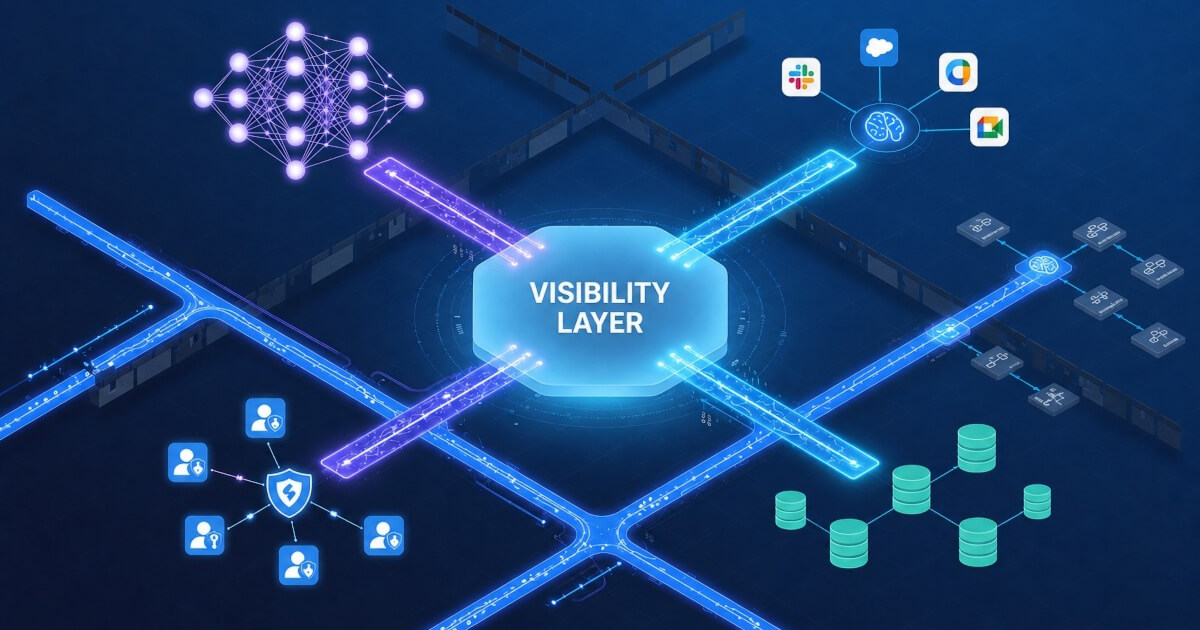
Sustainable AI adoption depends on visibility — and visibility depends on connecting data about identities, assets, and systems that today live in separate tools.
Managing Third-Party and SaaS Exposure in the AI Era
AI is increasingly delivered through SaaS ecosystems: CRM platforms, marketing suites, developer tools, analytics engines, and productivity applications. Each new integration introduces another dependency chain — and with it, another potential entry point for data leakage or compromise.
Traditional vendor security questionnaires offer no meaningful insight into this dynamic environment. AI features evolve weekly. Data flows expand without notice. And organizations rarely have a unified view of which external services have access to what information.
Leading organizations are shifting toward continuous, signal-based oversight:
- Real-time visibility into vendor access
- Mapping dependencies across applications and APIs
- Understanding how third-party AI features interact with internal data
- Modeling the “blast radius” if a partner is compromised
This level of oversight requires connected data, not manual processes. Without it, AI-related supply chain exposure becomes an undetected and unmanaged risk.
Countering Cognitive Deception Powered by AI
Deepfake audio, synthetic personas, and AI-generated impersonation attacks have become mainstream. Finance teams receive cloned-voice requests that sound indistinguishable from executives. Product and R&D teams face targeted attempts to extract intellectual property. These attacks bypass traditional controls because they exploit human trust and organizational speed.
Defending against this new class of threat requires:
- Clear verification workflows for high-risk decisions
- Elevated training for personas most likely to be targeted
- Behavioral anomaly detection across communication channels
- Identity-aware authentication for sensitive approvals
But these protections depend on correlating signals across communication, identity, and behavioral systems. Fragmented data limits detection. Unified context makes it possible.
Why Security Must Accelerate Innovation, Not Slow It
In less-regulated industries, the business imperative is speed — shipping faster, experimenting more often, and reducing friction across product and customer lifecycles. AI amplifies that advantage, but only if the underlying data is trustworthy, understood, and governed.
Organizations that are successfully scaling AI share three characteristics:
- They treat AI governance as a data visibility challenge.
Policies mean little without the ability to see how data moves. - They eliminate data silos before deploying AI at scale.
Fragmentation leads directly to inconsistent, unsafe AI outcomes. - They unify operational, identity, and data-lineage signals.
This is what turns AI oversight from a reactive function into an engineered capability.
In these environments, security becomes a growth lever — protecting IP, reducing procurement friction, increasing customer trust, and supporting faster time-to-market.
Call to Action: Begin With an AI Asset Inventory
The most effective starting point for safe, scalable AI adoption is a comprehensive AI Asset Inventory — a modern register of all AI-related components, whether intentionally deployed or informally created.
A meaningful inventory includes:
- All datasets feeding AI models
- All models in use (internal, vendor, open-source)
- All human and machine identities interacting with those models
- All SaaS tools embedding AI features
- All workflows that generate or consume AI outputs
- All lineage and governance information available today
- All unknowns revealed along the way
This baseline exposes fragmentation, shadow experimentation, and unmanaged dependencies — the exact issues that make AI unsafe or unscalable.
Because the truth is straightforward:
You cannot govern what you cannot inventory — and you cannot inventory what you cannot see across siloed systems.
Organizations that address this early build AI programs that are secure, resilient, and fit for rapid growth. Those that don’t will find themselves rebuilding governance only after something breaks.
More posts


Explore the pros and cons of building vs. buying a security data fabric. Learn how platforms like DataBee® can help accelerate security data management, insights, and compliance.

Explore how cybersecurity digital transformation breaks data silos, enabling smarter threat detection, compliance, and business agility.

Entity resolution connects users, devices, and applications into trusted data—enabling accurate security data correlation, detection, and compliance at scale.
Get the clarity you need to manage cyber risk.
Schedule your 30-minute demo to see how DataBee's AI-powered technology turns your data into fast, clear, defensible control and cyber risk clarity.